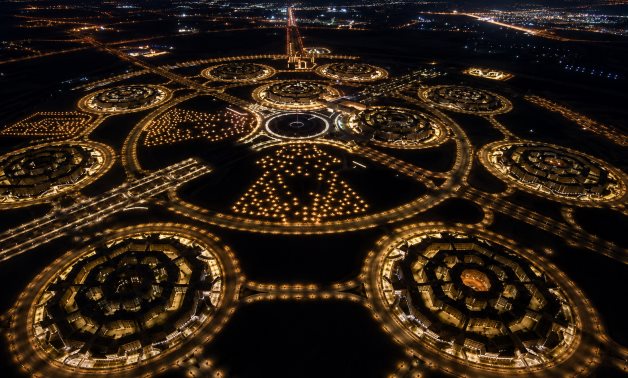
An aerial view of Egypt’s Strategic Command Headquarters in the New Capital.




CAIRO - 2 JULY 2026
In the New Capital, Egypt is building more than ministries and roads. At the center of its new state architecture stands the Strategic Command Headquarters, a sovereign project designed around readiness, coordination, deterrence, and national security.



In the New Capital, Egypt is not only building ministries, roads, towers, and public institutions. It is building a new command architecture for the state itself.
At the center of that transformation stands the Strategic Command Headquarters, one of the most symbolic and consequential projects in Egypt’s modern institutional development. More than a military complex, it represents a wider shift in how the Egyptian state thinks about readiness, coordination, deterrence, crisis management, and national security in a region where instability has become the rule rather than the exception.
President Abdel Fattah El-Sisi, Supreme Commander of the Armed Forces, inspected the Strategic Command Headquarters in the New Capital on June 7, in what the Presidency described as part of his close follow-up on the progress of work and readiness across different specializations. The Presidency said the project represents a “significant qualitative and quantitative advancement” in developing the capabilities of the Armed Forces.
This is not merely a relocation project from old Cairo to a new seat of government. It is part of a broader modernization of the state’s strategic capacity.
That phrasing matters.
It frames the headquarters not merely as a relocation project from old Cairo to a new seat of government, but as part of a broader modernization of the state’s strategic capacity.
For decades, Egypt’s national security environment was shaped by familiar challenges: border protection, conventional defense, regional diplomacy, and internal stability. Today, the threats are more complex.
The country sits at the center of several overlapping crisis zones. To the west, Libya remains fragile. To the south, Sudan’s war has created direct humanitarian and security pressures. To the northeast, Gaza continues to generate regional instability. In the Red Sea, maritime security has become a global concern. Beyond that, cyber threats, information warfare, terrorism, irregular migration, energy disruption, and supply-chain shocks have all become part of the modern security equation.

In such an environment, command is no longer just about issuing military orders.
It is about speed, information, coordination, and resilience.
The Strategic Command Headquarters reflects that shift. Its importance lies not only in its size or architectural presence, but in what it suggests about Egypt’s future model of governance and security: a state capable of bringing military readiness, institutional coordination, and crisis response under a more advanced and centralized framework.
According to project descriptions, the State Strategic Command Center, is the new headquarters of Egypt’s Ministry of Defense and spans around 22,000 acres, with approximately 50.5 million square feet of floor space.
Even if numbers alone do not explain the project, they reveal the scale of the ambition.
The most common mistake in reading the Strategic Command Headquarters is to treat it as a physical structure only.
It is not.
A headquarters of this kind is a message. It says that Egypt is investing not only in arms, equipment, and infrastructure, but also in command systems, institutional discipline, and long-term preparedness.
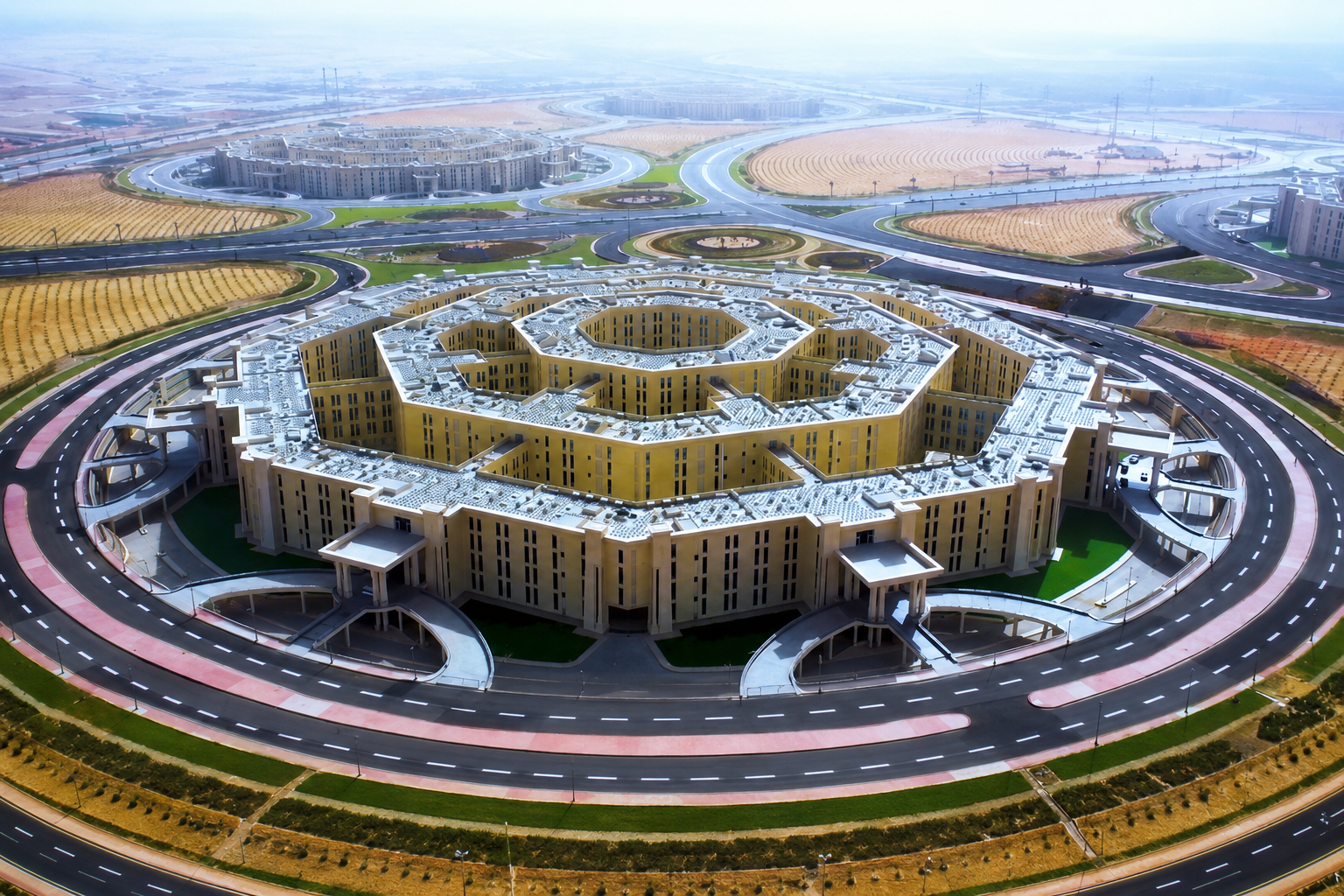
Beyond architecture, the Strategic Command Headquarters represents a broader transformation in state preparedness, institutional coordination, and long-term strategic planning.
It also reflects the logic of the New Capital itself.
The New Capital was designed as a new administrative and institutional center for the Egyptian state. Within that vision, the Strategic Command Headquarters acts as the sovereign anchor: the place where state security, military modernization, and strategic planning converge.
Its presence alongside other national institutions gives the New Capital a deeper meaning. This is not simply an urban relocation. It is an attempt to reshape the machinery of the state for the decades ahead.
The Presidency said El-Sisi’s inspection came as part of his monitoring of readiness across various specializations, underlining the operational dimension of the project rather than its architectural symbolism alone.
Egypt is not building a monument. It is building a system.
During the same tour, President El-Sisi also inspected the Egyptian Military Academy, where he met with students, reviewed the progress of the academy’s educational and training systems, and held an interactive discussion about their training activities. The Presidency said he stressed the need for maximum effort and continuous development of capabilities.
This connection between the Strategic Command Headquarters and the Military Academy is crucial.

A modern command center cannot function without a modern officer corps. Technology can support decision-making, but people remain the decisive factor. Training, discipline, strategic awareness, and intellectual preparation are what turn infrastructure into capability.
By placing the academy within the broader narrative of the Strategic Command Headquarters, Egypt is linking two levels of national power: the institution and the individual, the system and the officer, the command structure and the generation expected to operate it.
That is why the project should be read not only as a military headquarters, but as part of a deeper transformation in defense education, doctrine, and professional development.
In regional politics, symbols matter.
The Strategic Command Headquarters sends a message outward as much as inward. It signals that Egypt is investing in long-term military organization at a time when the region is increasingly defined by uncertainty.
For allies, it reinforces Egypt’s role as a state with functioning institutions, strategic continuity, and serious defense capabilities. For adversaries, it reinforces the idea that Egypt is not merely reacting to crises, but preparing for them.

This matters because deterrence is not built only through weapons. It is built through visible readiness, command discipline, infrastructure resilience, and the perception that a state can absorb shocks and respond coherently.
In that sense, the headquarters contributes to Egypt’s broader strategic posture.
It tells the region that Egypt’s Armed Forces are not simply modernizing platforms, equipment, or bases. They are modernizing the architecture of command itself.
The Strategic Command Headquarters also cannot be separated from the larger New Capital project.
The New Capital represents the state’s attempt to move beyond the pressure of old administrative geography. For decades, central Cairo carried the burden of ministries, security institutions, government offices, population density, traffic congestion, and symbolic state power all at once.
The new model seeks to create a more organized administrative environment, where institutions can operate with greater efficiency, security, and room for expansion.
Within that framework, the Strategic Command Headquarters occupies a unique position. It is the defense heart of the new state geography.
It stands as a reminder that national development and national security are not separate tracks. Roads, cities, energy networks, digital systems, and defense institutions are all part of the same state-building project.
The Strategic Command Headquarters adds another layer to Egypt’s development narrative: infrastructure designed for state continuity and national readiness.
Egypt’s modern development narrative has often focused on infrastructure: bridges, tunnels, ports, airports, rail networks, and new cities. But the Strategic Command Headquarters adds another layer to that story: sovereign infrastructure.
This is infrastructure designed not for commuters or investors, but for state continuity.
The timing of the project’s emergence is important.
Egypt is operating in one of the most volatile strategic environments in its modern history. Several neighboring states are either in conflict or facing deep instability. International trade routes are under pressure. Water security remains a major national concern. Regional alliances are shifting. New technologies are transforming the nature of conflict.
In such a moment, states that lack coordination, information capacity, and institutional discipline become vulnerable.
The Strategic Command Headquarters is therefore not a luxury project. It is part of a national response to a new era of risk.
It supports a broader idea: that Egypt must be able to monitor, plan, coordinate, and respond across multiple domains at once.
That does not mean militarizing the state. It means recognizing that modern national security is comprehensive. It includes borders, water, energy, food supply, cyber systems, maritime routes, internal stability, crisis response, and regional diplomacy.
A state that cannot coordinate these files quickly is a state exposed to pressure.
The architecture has attracted attention because of its scale and distinct design. But the political meaning of the project is more important than the shape of the buildings.
The headquarters represents centralization of strategic capacity. It represents institutional confidence. It represents the state’s desire to project permanence, discipline, and continuity.
In countries with long histories, major state buildings often serve as physical expressions of political eras. The Pentagon became synonymous with American defense planning. The Kremlin became a symbol of Russian state power. The Élysée and the Quai d’Orsay became symbols of French executive and diplomatic identity.
Egypt’s Strategic Command Headquarters may play a similar symbolic role in the coming decades.
It is likely to become one of the defining images of Egypt’s new state architecture.
The real significance of the Strategic Command Headquarters lies in the balance it tries to strike between two ideas: sovereignty and modernization.
Sovereignty means the ability of the state to protect its territory, institutions, resources, and national decision-making.
Modernization means the ability to do so with advanced systems, trained personnel, rapid coordination, and updated doctrine.
Egypt’s challenge has always been that it occupies a difficult geography. It is an African state, an Arab state, a Mediterranean state, a Red Sea power, a Nile Basin country, and a central actor in the Middle East.
That geography gives Egypt influence. But it also gives Egypt burdens.
The Strategic Command Headquarters is one answer to that burden.
It reflects a state trying to ensure that its institutions are prepared for a century in which crises will be faster, more complex, and less predictable.

The opening and operational development of the Strategic Command Headquarters mark a new chapter in Egypt’s defense story.
It is a move from scattered administrative legacy to integrated strategic planning.
From traditional command geography to a modern sovereign hub.
From infrastructure as construction to infrastructure as national capability.
The project’s importance is not only in what it is today, but in what it could become: a center for long-term strategic thinking, crisis response, defense readiness, and institutional continuity.
At a time when the region is surrounded by uncertainty, Egypt is sending a clear message.
The state is not only building for growth.
It is building for readiness.
Egypt’s Strategic Command Headquarters is not simply a military complex in the New Capital. It is a statement about how the state sees the future: faster crises, wider threats, deeper coordination needs, and a national security environment that demands resilience.
In that sense, the Strategic Command HQ stands as one of the most important symbols of Egypt’s new institutional architecture: a project where sovereignty, modernization, deterrence, and state continuity meet.

Be Social




Comments
Leave a Comment